
This article was published by The Energy Mix on Jan. 30, 2024.
By Christopher Bonasia
As the proportion of green jobs increases, experts expect the growth in employment will counterbalance job losses in the fossil energy sector, but they say it’s also crucial for workers to develop green skills.
While a recent report by LinkedIn documents a 22.4 per cent increase in jobs requiring at least one green skill between 2022 and 2023, the work force itself showed only a 12.3 per cent increase in green talent.
The share of jobs requiring at least one “green skill” grew by 9.2 per cent between 2018 and 2023, LinkedIn found. This rise in demand for workers to fill roles in the green sector came even as overall hiring slowed in 2023, with job postings requiring at least one green skill growing by over 15 per cent that year.
At the same time, “the median LinkedIn hiring rate for workers with at least one green skill is 29 per cent higher than the work force average,” the report found.
“One of the things we’ve seen over the past few years is a very consistent, steady increase in demand for green roles,” Sue Duke, head of global public policy at LinkedIn, told the Financial Times. “Last year, when we saw hiring being pulled back in most sectors, we saw the opposite trend when it came to green jobs and skills.”
Various factors drive rising demand for green workers, including clean energy investment driven by the U.S. Inflation Reduction Act and increased pressure on companies to focus on environmental and social outcomes.
Analysis by DeLoitte suggests this trend is likely to continue. Last spring, the firm said a 38.5 per cent rise in “green talent” was driven by the expansion of the renewable energy sector. It projected that strategic decarbonization policies could create more than 300 million additional green collar jobs around the world by 2050.
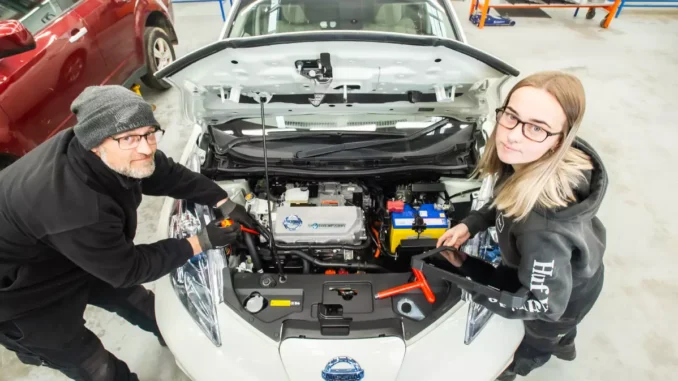
But so far, the number of workers developing the necessary green job skills has not kept pace with the demand. The trend extends to the green economy’s subsectors, like the electric vehicle industry, where skills growth is out of sync with EV demand. In the United Kingdom, for example, only 39,000 of 168,600 vehicle technicians are qualified to maintain EVs, despite a 40 per cent increase in EV sales in 2022. Over in the U.S., only 1.4 per cent of mechanics are EV certified, reports the Financial Times.
In some cases, workers face obstacles to acquiring green skills. For instance, not all companies pay employees to learn on the job. And workers who are not confident that investing in training or retraining will pay off are unlikely to foot the skills bill.
Spotty government funding adds to that uncertainty: As the Financial Times points out, the number of onshore wind jobs in the UK nearly halved after the government placed a de facto ban on new onshore wind projects in 2015.
“We are far from the green skills penetration that we need,” writes LinkedIn. “Our study reveals that just one in eight workers have green skills.”
“Put another way: Seven in eight workers lack a single green skill, at a time when the future of our planet depends on them.”

Be the first to comment