
This article was published by The Energy Mix on Jan. 27, 2026.
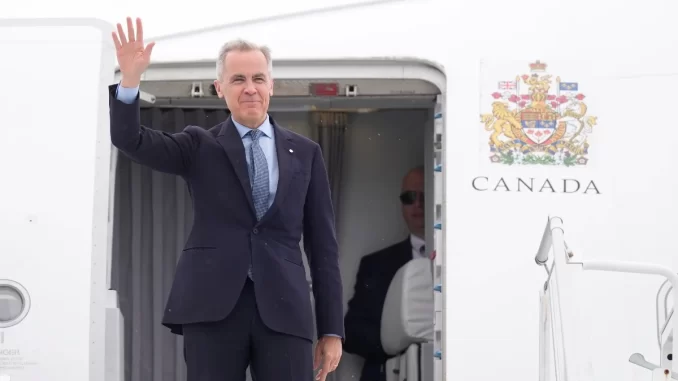
On the heels of a new strategic partnership with China, and with Prime Minister Mark Carney planning a trip to India later this year, the plan to reduce Canada’s trade dependence on the United States is beginning to yield closer connections with the world’s first two electrostates.
As Trump threatened a 100% tariff against Canadian products in response to a deal with China that he initially praised, at least one Chinese electric vehicle manufacturer looked to be preparing for an expansion into Canada, while a federal official said Canada wanted to be the first country in North America to build an EV with Chinese know-how.
Meanwhile, just as China is receiving wide recognition as the world’s first electrostate, a small flurry of news and analysis had India rapidly emerging as the second, advancing farther and faster than China did when it had achieved the same degree of economic development.
‘Foreign Troubles’ for U.S. Automakers
In their strategic partnership announced Jan. 16, Canada agreed to sharply reduce tariffs on electric vehicle imports from China, while China offered up tariff relief for Canadian canola, peas, pork, and seafood. Canada will slash duties on up to 49,000 Chinese EVs per year, rising to 70,000 by 2031, to a “most-favoured-nation tariff rate” of 6.1%. Within five years, as well, more than half of those vehicles are meant to be affordable EVs with an import price of less than $35,000.
At the time, CBC said Ottawa would soon release a strategy to expand the auto sector and “leapfrog” the U.S., with “preferential access to foreign automakers that manufacture vehicles in Canada.”
Scarcely a week later, the New York Times reported that the U.S. industry’s “foreign troubles” now extend to Canada, after U.S. trade policy “devastated the Canadian auto industry and pushed the country to reach an agreement that will make it easier for Chinese companies to sell cars there.” That could make the Canada-China agreement “an ominous development for U.S. automakers that are already struggling to stay relevant outside North America,” the Times wrote.
“General Motors and Ford Motor—the two largest U.S.-based car manufacturers—have been steadily losing customers in Asia, Europe, and Latin America, as Chinese carmakers have gained ground,” the news story stated. “If they lose significant ground to Chinese companies in Canada, Mexico, and other countries where they once dominated, Ford and GM could gradually become niche manufacturers.”
“There’s a real danger that the market for U.S. carmakers is going to largely be the U.S., and only that part of the U.S. market that wants big SUVs and trucks,” Erik Gordon, a professor at the University of Michigan’s Ross School of Business, told Times auto industry reporter Jack Ewing.
“Historically, U.S. trade policy regarding automotive has been mirrored in Canada,” added George Washington University engineering professor John Helveston, in an interview with the South China Morning Post. But now, “Canada is realizing that the U.S. industry is perhaps not the only one to be tied to,” a measure of both the impact of Trump’s tariff wars and the wider decline of U.S. leadership.
In Canada, the partnership has analysts arguing that lower costs will help consumers, although concerns about supply chains, industrial strategy, environmental impacts, and “strategic dependence” have yet to be resolved.
“The quota is too small to translate into a cheap-car bonanza for Canadian car shoppers,” the Globe and Mail writes. “But it is likely to increase competition among automakers, in China and elsewhere, to make $35,000 EVs fit for the Canadian market.”
The first imports will likely come from western automakers with Chinese production lines, notably Chinese-owned Volvo, Buick, and Elon Musk’s Tesla, the Globe says. But “China’s own brands won’t take long to show up in Canada,” the news story states, citing Canadian Black Book senior manager Daniel Ross, and they’ll want to build their profile “by focusing on models that meet North American expectations in terms of features, style, and size.” That will put them in competition “with compact and subcompact SUV segments, which, together, currently make up about half of the Canadian market.”
Late last week, the Globe reported that China’s Chery Automobile Co. Ltd. was laying the groundwork for a Canadian sales network, with at least three auto industry veterans saying they’d been contacted by recruiters who indicated they were working for Chery. The company is also considering building cars in a UK plant owned by Jaguar Land Rover, the Financial Times writes.
The Globe also reports on the difficulties that Chinese manufacturer BYD ran into when it tried to set up manufacturing operations in Ontario a few years ago.
The Two Electrostates
The trade deal earlier this month is just one part of an economic diversification strategy that had Carney concluding deals with the United Arab Emirates and Qatar over the last month. With International Trade Minister Maninder Sidhu now calling for closer trade ties between Canada and India, Carney is planning a visit as soon as March, Reuters reported in an exclusive this week, with indications of trade talks in Brazil and Australia later this year.
For a few years, China has been seen as the world’s first electrostate, with renewable energy and energy storage investments that far exceed the activity in any other country. Earlier this month, Carbon Brief talked to nearly a dozen leading experts in Chinese energy and climate policy to get a sense of what to expect in 2026—the year when the country will publish a set of five-year targets that “could boost—or moderate –the pace of its energy transition.”
For more than 18 months, analysis by Carbon Brief and others has shown China’s carbon dioxide emissions either flat or falling. This year, new non-binding emission targets and an expanded carbon market are expected to take effect, even as extreme weather increases the importance of climate adaptation “while also adding to the challenge of advancing clean energy.”
Already, though, renewable energy has already replaced natural gas as “the leading replacement for coal demand in China, with growth in solar and wind generation largely keeping emissions growth from China’s power sector flat,” Carbon Brief reports. Nikkei Asia says China installed three times more battery storage capacity than the U.S. in 2025.
Now India is “electrifying faster and using fewer fossil fuels per capita than China did when it was at similar levels of economic development,” Bloomberg says, citing analysis by the UK’s Ember energy think tank. “It’s a sign that clean electricity could be the most direct way to boost growth for other developing economies, too.”
The government of Prime Minister Narendra Modi “is considering new plans that would double India’s coal power capacity by 2047, and the country’s oil consumption growth was set to outpace China’s last year,” Bloomberg writes. “But the South Asian economy’s coal and oil consumption per capita is a fraction of what China’s was at similar income levels. In absolute terms, India’s fossil fuel consumption is growing at slower rates than China’s today.”
No More Engine for Oil and Gas Growth
Energi Media publisher Markham Hislop says the Ember analysis has wider implications.
“It suggests that India, the country long assumed to be the last great engine of global oil and gas demand growth, may already be bending away from fossil fuels faster than China did at a comparable stage of development,” Hislop writes. “That version of India’s energy future undermines the strategic assumptions underpinning energy policy in exporting nations from the Middle East to North America, including Canada.”
The driving force behind that shift is “simple and structural,” he adds, citing Ember. “China had to pioneer modern electric technologies at scale. India does not. It is industrializing at a moment when solar panels, batteries, and electric vehicles are abundant, cheap, and improving every year. India is not taking a fossil detour because it no longer makes economic sense to do so.”
Which in turn leads Hislop to the implications for fossil fuel exporters. “If India’s oil and gas demand really is nearing a peak, or never reaches the levels long assumed, the implications ripple outward.,” Hislop says. “For global markets. For geopolitics. And for countries like Canada that have built their long-term energy ambitions on the idea that someone, somewhere, will always need more hydrocarbons.”
In his Electrotech Revolution newsletter, Ember strategist and report co-author Kingsmill Bond cites faster solar deployment, much lower per capita coal use, rapid growth of electric vehicles, much lower oil demand in transport, and a “similar rapid electrification pathway” as factors that could make India’s “electrotech fast-track” more effective than China’s “fossil detour” en route to electrostate status.
“This energy path avoids deep fossil fuel dependency while positioning the country to supply electrotech to the world,” he writes, in what amounts to a “new path for emerging economies. India is showing other countries how to take a cheaper, faster, cleaner pathway to the electrotech future.”

Be the first to comment